
Introduction
The Vickers Hardness Test is one of the most trusted and widely used methods for measuring the hardness of metals and industrial materials. Industries such as automotive, aerospace, manufacturing, metallurgy, quality control laboratories, and heavy engineering rely on this testing method to ensure product strength, durability, and performance.
At Swastic Solutions, we provide advanced hardness testing machines, material testing equipment, spectrometers, microscopes, NDT equipment, and industrial laboratory solutions designed for accurate and reliable testing applications.
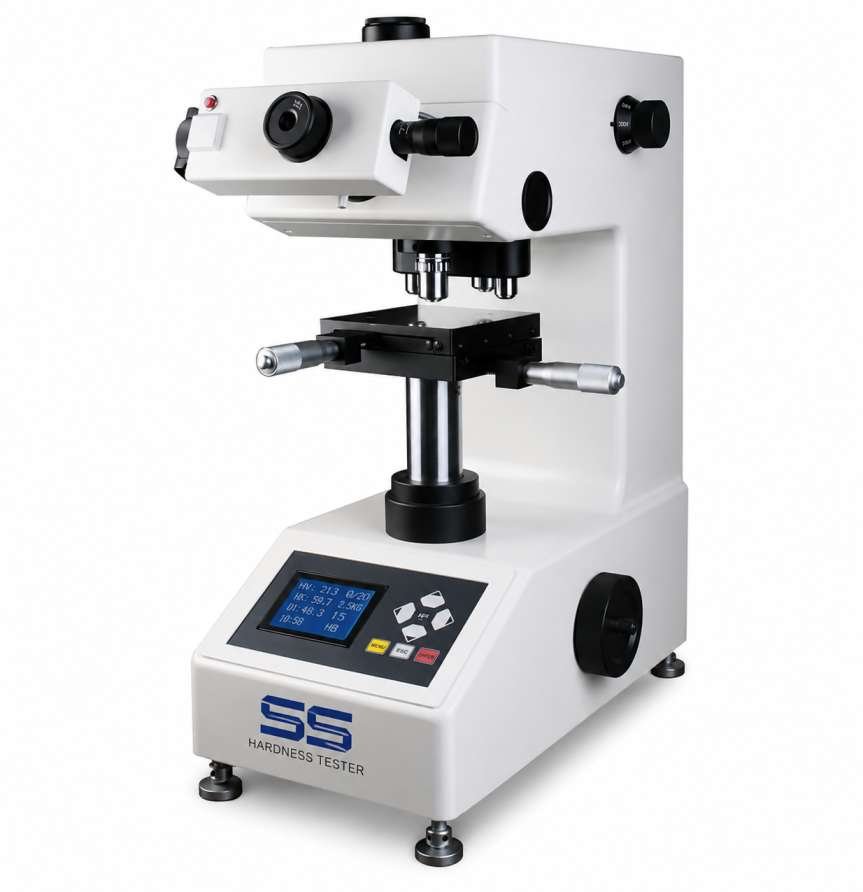
What is the Vickers Hardness Test?
The Vickers Hardness Test was developed in 1921 as an alternative to traditional hardness testing methods. It is used to determine the hardness of metals, alloys, coatings, and other industrial materials.
The test measures a material’s resistance to deformation by applying a controlled load through a diamond-shaped indenter.
The hardness value is expressed as:
- HV (Vickers Hardness Value)
- DPH (Diamond Pyramid Hardness)
This testing method is highly accurate and suitable for both hard and soft materials.
How the Vickers Hardness Test Works
The Vickers testing procedure involves several important steps:
1. Surface Preparation
Before testing, the material surface must be:
- Clean
- Smooth
- Properly polished
A flat surface ensures accurate indentation measurements.
2. Applying the Load
A diamond indenter shaped like an inverted pyramid is pressed onto the material surface using a specific force.
The load remains applied for a fixed period called the dwell time.
3. Measuring the Indentation
After removing the load, the indentation left on the material is measured using an optical system or digital software.
Smaller indentation means:
- Higher hardness
Larger indentation means:
- Softer material
Types of Vickers Hardness Testers
Micro Vickers Hardness Tester
Used for:
- Thin materials
- Small components
- Coatings
- Precision applications
Macro Vickers Hardness Tester
Used for:
- Large industrial components
- Steel testing
- Heavy-duty applications
Digital Vickers Hardness Tester
Features:
- LCD display
- Automatic measurement
- Improved accuracy
- Faster testing
CCD Camera Based Vickers Hardness Tester
Advanced systems include:
- CCD camera
- Analytical software
- Automated optical measurement
- Automatic report generation
These systems are ideal for industrial quality control laboratories.
Advantages of the Vickers Hardness Test
1. Wide Application Range
The Vickers method can test:
- Steel
- Metals
- Alloys
- Plastics
- Coatings
It is one of the most versatile hardness testing methods available.
2. High Accuracy
The diamond indenter provides:
- Precise indentation
- Reliable measurements
- Consistent results
3. Minimal Damage to Sample
The test is considered nearly non-destructive because it creates only a small indentation on the material surface.
4. Suitable for Quality Control
Industries use Vickers testing for:
- Material verification
- Product quality inspection
- Manufacturing quality control
Industries Using Vickers Hardness Testing
The Vickers Hardness Test is commonly used in:
- Automotive Industry
- Aerospace Industry
- Metal Manufacturing
- Heat Treatment Plants
- Research Laboratories
- Engineering Workshops
- Industrial Quality Control Labs
Essential Components and Accessories
Diamond Indenter
A high-quality diamond indenter ensures:
- Accurate testing
- Long operational life
- Reliable performance
Test Blocks
Hardness test blocks are used for:
- Calibration
- Accuracy verification
- Quality assurance
Optical Measurement System
Modern systems include:
- Microscope
- CCD Camera
- Digital optical analysis software
Limitations of the Vickers Hardness Test
Although highly reliable, the method has some limitations:
1. Surface Preparation Required
The material must be properly polished for accurate results.
2. Slower Testing Process
Compared to Rockwell testing, the Vickers method requires more testing time.
3. Higher Equipment Cost
Advanced optical systems and CCD software increase machine cost.
Why Choose Swastic Solutions?
Swastic Solutions provides high-quality industrial testing equipment with reliable service and technical support.
Our product range includes:
- Vickers Hardness Testers
- Rockwell Hardness Testers
- Universal Testing Machines
- Spectrometers
- Metallurgical Microscopes
- NDT Equipment
- Material Testing Machines
- Industrial Consumables
We focus on:
- Competitive pricing
- Quality products
- Fast support
- Industrial testing solutions
Conclusion
The Vickers Hardness Test remains one of the most accurate and reliable hardness testing methods used in industrial applications today. Its versatility, precision, and ability to test a wide range of materials make it an essential solution for quality control and material analysis.
Choosing the right hardness testing equipment is important for ensuring accurate results and long-term operational efficiency.
Swastic Solutions offers advanced industrial testing solutions designed to meet the needs of modern industries and laboratories.
Contact Swastic Solutions
Email: enquiry@swasticsolutions.in
Website: www.swasticsolutions.in